Showing posts with label Logic. Show all posts

Saturday, May 28, 2016

The Story of Science

“I’m convinced, and I hope to convince you, that science is not just for scientists. In the twentieth century, we compartmentalized knowledge; in the information age, that doesn’t make sense. Today, you can be a hermit on a mountain peak and still have access to the world’s learning. For scholarship to be so available, so democratic, is unprecedented in world history. To use that opportunity well, we all need to be generalists first. And no field of knowledge is as basic or as creative as science. . . . that human quest to understand the universe underlies almost all other creativity."
-A Writer’s Reasons, from The Story of Science, Aristotle Leads the Way
The above quote is from Joy Hakim's website. She is the author of a 3-part series called "The Story of Science." We've been slowly making our way through the first book, Aristotle Leads the Way, this year, alongside our studies of physics and history and philosophy. This is the book that ties so much of the subject matter together. Early scientists were writers and philosophers. They were historians and mathematicians. The science could not be separated out into it's own compartment, the way it so often is now.  We find ourselves frequently moving from this book to the Ponderables books on Philosophy, Math, and Physics.


We've been using the companion student workbook, which is helpful for reinforcing material, but I'm not sure we'll use the workbook for the next book, as we're using Hakim's books as a supplement, rather than a core. One could certainly use it as a core curriculum in middle school (5th-8th grades?). The material is very readable and could be a great science spine in earlier years. (And this is exactly the kind of material that makes me want to homeschool another child through the younger years now that I've learned the ropes!!) As an older student, Mane is studying more detailed and technical science material. This book has been a great "story" to tie it all together and to make sense of how science impacts the world. And, although it's very readable for younger students, it is fantastically well-written and appealing to older students and adults...sort of in the way a great, classic picture book can have layers of meaning.

Friday, May 27, 2016

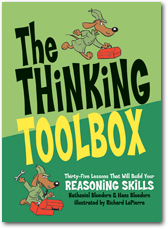
The Thinking Toolbox

A fabulous follow-up to The Fallacy Detective, The Thinking Toolbox has been a delightful addition to our logic studies this year. Again, I appreciate the formatting of these books - a quick lesson with examples and cartoons followed by a quiz. The quiz is typically 10-15 scenarios that relate to topics from the current and previous chapters. So, students circle back around to previous material on a regular basis. This book has a generous and light-hearted way of covering subjects like the difference between friendly, respectful arguing and angry, disrespectful arguing. The word "argument" generally gets a bad rap, but it isn't necessarily negative. It's how we argue that determines whether it's a positive or negative conversation. The book also covers scenarios when it is not appropriate to argue and when pointing out the logic in a situation is counter-productive. This is a lesson we could all probably stand to learn! The examples range from silly to serious and frequently targeting political, theological, and cultural issues: the existence of God, evolution, and taxes.

A side note: These books do have a political and religious bias. It isn't overwhelming. I just see it popping up in the use of particular examples. Examples regarding the existence of God are obviously biased toward faith and belief, rather than atheism (which is fine with us, since we believe in God). This book presents a sample conversation near the beginning that seemed to favor young-earth creationism. One could easily extend the example, though, to discuss responses to the arguments presented. The authors do not take a position, though they do discuss how the creationist was able to make his argument better by planning for the responses of the evolutionist. It's a valuable lesson about looking at your own argument from the opposite perspective. Overall, it's not enough to stop me from recommending this book to others.

Tuesday, May 24, 2016

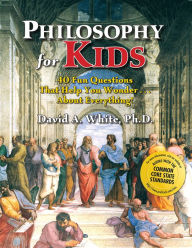
Philosophy for Kids

We received Philosophy for Kids by David A. White as a Christmas gift in December from Grandma Philosopher...and we've been answering questions like "What is Friendship?" "How do we define intelligence?" and "Is charity a human obligation?" ever since...
The book is laid out in a fairly simple format. Each chapter/question is about 3 pages long and presents a question along with the perspectives of 1 or 2 well-known philosophers. The author leads the student through a series of questions to sort out their own thoughts and finishes the chapter with MORE questions for further discussion or writing. We've been using those final questions as writing assignments. By the time we're finished with this book, Mane will have her own philosophy book! We've enjoyed working through the questions and making connections to The Story of Science (more on that in another post) and the Ponderables Philosophy book:

Monday, June 8, 2015

Game Schooling - Munchkin Quest

Looking for a fun, humorous, strategy game to play on a long, rainy evening? Munchkin Quest is your answer!  Be warned that it takes a while to learn how to play. And the game cards can be slightly inappropriate - in a medieval and/or renaissance fair kind of way. I wouldn't attempt to play with kids under 12. Having said that, it's one of our games of choice for a family game night. Players build the board as they go. Every time a player adds a new room to the board, a monster appears, and they have to fight the monster by combining dice rolls with the cards they have in play. As players defeat monsters, they move up levels until they return to the center of the board and fight the "Boss Monster" to win the game. Turns are long and can include adding new rooms, fighting monsters, running from monsters, dropping treasure, searching for treasure, scoring cards, and giving charity! (This gives other players plenty of time to eat all the snacks, get something to drink, and change the music!) It's a great game for practicing strategy and logic...and laughing a lot!

Friday, April 24, 2015

Logic Curriculum - The Fallacy Detective

This was one of the best Christmas presents ever! We received The Fallacy Detective by Nathaniel Bluedorn & Hans Bluedorn from Mane's former-philosphy-professor grandmother. It had been on our wish list since the beginning of the school year. So, we dug right in as soon as we got it. Lessons are short, straight-forward and much easier to understand than what we were found in An Illustrated Book of Bad Arguments. Each chapter is one lesson and include cartoons, examples, and a quiz. The quiz at the end of each chapter includes both the newly learned fallacy and all of the fallacies from previous chapters. We can easily cover a chapter in a half an hour, or we can spend a whole morning discussing the example arguments in the quizzes at the end of the chapter. The sample arguments relate to real world issues like belief in God, taxes, the Revolution, education spending, homework, chores, and global warming. 

Recently Mane read a ridiculously horrible parenting article by an expert, who shall remain nameless, and she was able to break the whole 8-page article down using what she knows from the first 12 chapters of The Fallacy Detective. She was so proud of her ability to read something by an adult expert and think about it critically. She wrote a paper describing the difficulties of the article, and we used this as an opportunity to work on writing skills and tactful argument, as well as critical thinking and logic.

Looking forward to the next two-thirds of the book!

Thursday, April 23, 2015

Game Schooling - Chess


Do I really need to say more? You all know what chess is, right? But I always forget how much I enjoy playing, and the educational benefits are considerable. Chess is a game of strategy, requiring a whole lot of both planning and flexibility. There are entire conferences and considerable research studies devoted to the benefits of playing chess. From The Susan Polgar Foundation: Excel Through Chess:

Countless researchers and studies have shown over the years that chess does indeed strengthen a child's mental clarity, fortitude, stability, and overall health. Many schools are now finding chess as an inexpensive but essential way of helping kids grow mentally. In this technologically driven world, chess helps aid in the synthesis and growth of certain areas in the brain and mind where many children can benefit as they grow older from the game.
In 1986 a program called Chess-In-The-Schools was introduced in New York City to promote chess as a tool for developing essential skills for school children. The program is still going strong today. In 1992 New Jersey passed a bill requiring all students in New Jersey schools to be taught to play chess in the 2nd grade!  And just this April a senator in California introduced a bill to designated October as "California Chess Month," recognizing both the educational value and popularity of the game.

For an interesting history of chess, beginning with its origins in India around 600AD, check out the United States Chess Federation website. Fortunately for all of us, chess is available in a multitude of forms today - from high-end, hand-carved display games to mobile apps, and resources for everything from basic game rules to complex strategies can be found all over the internet. So, go dig out the old dusty box in your game closet, and start playing chess!!

Monday, January 26, 2015

Game Schooling - Puzzles

I know many seasoned homeschool parents who will say that their number one must-have homeschool tool is puzzles. And there's a fair amount of research about the educational value of jigsaw puzzles. Puzzles provide practice in deductive reasoning, categorization, analysis, sequencing, problem solving, spacial awareness, and scanning - skills that transfer especially well to the "academic" subjects of reading, math, and science. For the kinesthetic learner, puzzles can also be a hands-on way to work with subject matter. Example: We recently picked up a puzzle map of New York City. We'll be visiting New York this summer, and the puzzle is providing all of us with a hands-on way of familiarizing ourselves with the city.  We're developing a sense of the direction, distance, and general layout of places in the city. The puzzle is a conversation piece, as we discover street names and buildings, and it's a starting point for new learning about the city.

AND, "puzzling" is a fun social activity:


Saturday, January 24, 2015

Game Schooling - Qwirkle


We added Qwirkle to the stack of games at our house over Christmas break this year. It came highly recommended from a educator friend, and is the winner of several game awards. I've heard is described as scrabble with colors and symbols rather than letters. MindWare describes the game in this way:
Qwirkle is as simple as matching colors and shapes, but this game also requires tactical maneuvers and well-planned strategy. Earn points by building rows and columns of blocks that share a common shape or color. Look for opportunities to score big by placing a tile that touches multiple pieces with matching attributes.
We've now played Qwirkle over and over (since our Christmas purchase), and every time we play, the high score gets higher! We're beginning to wonder how high it's actually possible to score in this game. One of the keys seems to be flexible thinking - the ability to shift from one plan to another and see all the various ways to play the same piece. There's also some balance to be had between cooperating with other players and throwing a wrench in the perfect rows and columns!

For serious Qwirkle players, MindWare has created Expansion Sets, Qwirkle Cubes (like the tiles, only multi-sided dice!), and Travel Qwirkle.

Friday, January 23, 2015

Game Schooling - Mancala


I've always found mancala to be such a beautiful and simple game. Who doesn't enjoy handfuls of gems? We used to play mancala with egg cartons when Mane was younger, but a friend gave us this lovely wooden mancala board last year!


Mancala is easy to learn and quick to play - deceptively quick and easy, for a surprising amount of strategy comes into play as players become more experienced. Dr. Gwen Dewar at Parenting Science describes mancala as a "count and capture" game that requires strategic mental planning, deductive reasoning and math skills. (For a blow-your-mind research paper on the mathematics involved in mancala, check this out: Mancala Games - Topics in Mathematics and Artificial Intelligence.) According to The Geek Parent, mancala may be the oldest board game in the world!! Clearly, this game has a lasting appeal. Wikipedia has a fantastic listing of various mancala games and links to their rules here: Wikipedia: Mancala Games.


And here's all you really need to get started (from education.com):


Also known as "count and capture" games, mancala games encourage kids to conduct thought experiments, counting tokens and comparing tactics in their heads before they move a game piece. Such qualities have inspired educators in Africa, Europe, and the United States to bring mancala into the classroom.

Does playing mancala actually sharpen math and thinking skills? To date, nobody has performed the relevant experiments to find out. However, competent performance requires counting and the mental movement of game tokens across a game board. And research suggests that good players use abstract or hypothetico-deductive reasoning (Retschitzki et al 1986). - See more at: http://www.parentingscience.com/mancala-games.html#sthash.xzhVgHdT.dpuf
Also known as "count and capture" games, mancala games encourage kids to conduct thought experiments, counting tokens and comparing tactics in their heads before they move a game piece. Such qualities have inspired educators in Africa, Europe, and the United States to bring mancala into the classroom.

Does playing mancala actually sharpen math and thinking skills? To date, nobody has performed the relevant experiments to find out. However, competent performance requires counting and the mental movement of game tokens across a game board. And research suggests that good players use abstract or hypothetico-deductive reasoning (Retschitzki et al 1986). - See more at: http://www.parentingscience.com/mancala-games.html#sthash.xzhVgHdT.dpuf

Friday, December 5, 2014

Game Schooling - Sequence

She won!
Sequence comes in a bazillion different forms (States & Capitals, Letters, Numbers, Bible, Travel, Jumbo...), but all we've got here is the original playing card version. I realized as I was playing with my friend's 5yr old the other day how valuable this game is, not only for number recognition, but also for eye scanning and tracking skills (same principle as word finds). This is helpful for both the pre-reader and readers, who are building fluency. Having read a whole lot about dyslexia, I'm aware that eye training exercises can be part of skill-building and therapy for kids with dyslexia. Hats off to another fun learning game!

We let the little guy have the edge of the board for his tokens!


Friday, November 21, 2014

Game Schooling - Gobblet


Gobblet is another logic game, a smart spin-off from tic tac toe. Mindware.com says:
This game has won more awards than we can fit in this space-and no wonder, with astonishingly easy rules and addictive, fast-moving play. Players place four pieces in a row to win, "gobbling" their opponent's pieces. A wonderful exercise in strategy and logic.

This is another game we received when Mane was about 5, and it was an instant hit with both older and younger folks in the family. I even had a good friend of mine playing round after round with me on a camping trip a few summers ago! As Mane gets older, her play gets more sophisticated. It's great practice for learning to stay focused and attentive, too.  It reminds me of chess because of the way that you have to "see" several different possibilities for your opponent's next move. In Gobblet you have to plan for bigger pieces to be able to "gobble" littler pieces and strategically place the larger pieces that cannot be "gobbled."


Friday, November 14, 2014

Game Schooling - Blokus


I had a lot of fun this week teaching my friend's 5yr old to play Blokus! (And the 2yr old played his own pieces with help from both of us)! In 2011 Blokus was featured in the journal Mathematics Teaching in Middle School, and was cited as teaching students to "exercise spatial awareness, analyze attributes of two-dimensional shapes, compare patterns, and use logic -all of which encompass NCTM's Content Standards."

We started playing Blokus when Mane was five and received it as a Christmas gift. The whole family loved the game. We took it on a family vacation, and it was enjoyed by the 5yr old, the 17yr old, and both parents! That's definitely a win! Blokus gets more complicated as players develop the skills listed in the journal article. A review at The Guide for Toys says this:
Blokus Classic is an award-winning game of strategy in which players compete to be the first to place each of their 21 colored pieces on the game board.  With each color beginning at one corner of the board, each piece must touch at least one other piece of the same color but only at the corners.  With every move, players use thinking skills for strategical moves and blocks.  The game ends when all players are blocked from laying down any more pieces. The player with the highest point total based on number of pieces played and any bonuses, wins.


Monday, October 13, 2014

Game Schooling - IZZI

We found this logic puzzle at the thrift store the other day...solvable in dozens of different ways - if you can manage to solve it all!! Simply match up the edges of each piece until you've build the entire 8x8 square:


It's a little like trying to do a rubics cube - infuriating and addicting.

Monday, October 6, 2014

Logic and Philosophy at Peregrin House

I am so excited for some of the new things we're studying this year. Next, after Game Schooling, on my list of things to share is Logic and Philosophy! Yay! First we began with this marvelous book we found online called An Illustrated Book of Bad Arguments.

After reading the first chapter of the Bad Arguments books, about Arguments from Consequences, Mane wrote her own Bad Arguments. For examples, "If all the cars in the world disappeared, I would get to ride a horse, and I like riding a horse. Therefore, all the cars in the world will disappear." Now there's an "Argument from Consequences" for you. Check this one out: "Nothing is better than chocolate. Broccoli is better than nothing. Therefore, broccoli is better than chocolate." That's an equivalency argument. Awesome.

We're looking forward to using the Center for Philosophy for Children later this year to explore philosophical questions through children's literature and find ethical dilemmas to discuss and argue (with our Bad Arguments). Their website is simply crammed with ideas for developing the philosophical minds of children. Grandma is going to be so proud (that's Mango's mama, the philosophy professor).

Last year we did a whole lot of logic puzzles: Deducibles, Mind Benders, and Sudoku. This year we're hoping to build on some of those logic and reasoning skills to make real world applications.

Related Posts with Thumbnails