Wednesday, October 8, 2014

American Chemical Society

Did you know that the American Chemical Society has a FREE chemistry curriculum for middle school students? You can find it here: middleschoolchemistry.com. The book is available for free download. Lessons include activity sheets, simple animation videos, labs and assessments! The lessons are lab-based, meaning that students learn by doing. Every Single Experiment we have tried from this curriculum has been successful, which is not something I've been able to say for other science lessons I've found online. I am totally impressed with this as an inquiry-based intro to chemistry!

In our first week, we made thermometers and learned about molecules in motion...


We made rain and frost...in lessons about evaporation, condensation, sublimation, deposition...


We watched alcohol, water, and oil separate out into three layers in our lessons about density...


I cannot say enough good things about how these lessons systematically reinforce concepts, particularly if you actually work through all of the labs and questions for each chapter. Embedded in the labs are lessons on the scientific method, variables and constants, control groups, and confounding factors. 


Hats off to the American Chemical Society! I am looking forward to digging into their other resources when we finish this set of lessons!

Tuesday, October 7, 2014

Game Schooling - Games for the younger set...

I also have the great pleasure of walking alongside a friend of mine as she begins the homeschool journey. Her kids love to play games at my house, too!

Among the favorites:

Tenzi - Throw a set of dice (Tenzi is supposed to be with 10 dice, but we started with 5 and worked our way up.) Decide on which number you're going to "collect." Keep the dice showing that number and throw the rest of the dice again. Keep any of the number you are collecting, and then throw the dice again...until all your dice are gone. With older children this can be a speed game. This works on counting and number recognition for the smaller kids:


War - Remove non-numeric cards from the deck and deal the rest between 2 players. Players turn up their top card at the same time. Whoever has the higher number takes the trick. Keep playing until all the cards are gone. Then practice counting even higher by counting who has the most cards!:


Hide and Eek - This game works on the concepts of odd/even and higher/lower for numbers 1-100. There is also a little memory work involved for cards that do not remain face-up. And there is some strategy for where to move the mouse once you've rolled the dice and know whether you're trying to land next to numbers that are odd/even or higher/lower:


Scrambled States of America - This game works on letter recognition (example: find your states the begin with the letter "A") and syllables (example: find a state whose capital has 3 syllables) along with state recognition by shape and location. Fun and quick enough for the big kids to enjoy with the little kids. Bigger kids will catch on to state capitals and nicknames, but this game is not so rigorous that I would include it in the learning games for middle schoolers:

Monday, October 6, 2014

Logic and Philosophy at Peregrin House

I am so excited for some of the new things we're studying this year. Next, after Game Schooling, on my list of things to share is Logic and Philosophy! Yay! First we began with this marvelous book we found online called An Illustrated Book of Bad Arguments.

After reading the first chapter of the Bad Arguments books, about Arguments from Consequences, Mane wrote her own Bad Arguments. For examples, "If all the cars in the world disappeared, I would get to ride a horse, and I like riding a horse. Therefore, all the cars in the world will disappear." Now there's an "Argument from Consequences" for you. Check this one out: "Nothing is better than chocolate. Broccoli is better than nothing. Therefore, broccoli is better than chocolate." That's an equivalency argument. Awesome.

We're looking forward to using the Center for Philosophy for Children later this year to explore philosophical questions through children's literature and find ethical dilemmas to discuss and argue (with our Bad Arguments). Their website is simply crammed with ideas for developing the philosophical minds of children. Grandma is going to be so proud (that's Mango's mama, the philosophy professor).

Last year we did a whole lot of logic puzzles: Deducibles, Mind Benders, and Sudoku. This year we're hoping to build on some of those logic and reasoning skills to make real world applications.

Sunday, October 5, 2014

Game Schooling - Mad Libs card game

Mane LOVES Mad Libs. I don't think I can express in words just how happy Mad Libs make her. If we get her nothing but Mad Libs books for her birthday, Christmas, and Chanukah this year, she would be over the moon. This is serious.

So, when I saw a Mad Libs card game at the thrift store for $1 the other day, I bought it. Don't let the serious face fool you, Mad Libs require your full attention:


As most of you probably know (but just in case you don't), Mad Libs are great for learning parts of speech and sentence construction. The game is played like Rummy, requiring players to make sentences of different lengths for each of six rounds. Cards are color coded for parts of speech.

We'd love to see Mad Libs get rid of the words "weirdo" and "dummy," though, and we'd love to see extension sets with better vocabulary. This game, which can be played similarly, is on our wish list: You've Been Sentenced.

Saturday, October 4, 2014

Game Schooling - Bible Challenge

It's been a struggle for me to find what I'm looking for in a Bible/Theology study for Mane. As a 7th grader, she's past just learning the basic stories but still needs reinforcement of the facts and practice finding things in scripture. There's a whole lot I have to say about teaching and studying theology for kids and middle schoolers, but today I'll just feature the games we've been using as that base for solidifying the facts and scriptures...


Mane made a set of these popsicle sticks with the books of the Bible written on them. They are color coded for genre. She is using them as a way to learn the order of the books. Scrambling them up and putting them back in order is great practice!

We are also playing a game called Bible Challenge as a part of our regularly scheduled curriculum! I grew up playing an older version of Bible Trivia, and I credit that game with helping me learn a great deal in a way that I still remember it today. This version does not give multiple choice answers to the questions, making it a bit more challenging. Players collect rings in seven different colors representing categories of questions in order to win the game.

Mango recently sent me a link to a American Radio Works radio show called The Science of Smart that was primarily about how people learn and retain information. Researchers have found over and over again that the best way to study information in order to retain it is to be quizzed (or to quiz yourself) on that information. It seems to me that trivia games are a great way to accomplish that repeated quizzing that helps us remember!

Friday, October 3, 2014

Game Schooling - Prestel Art Game

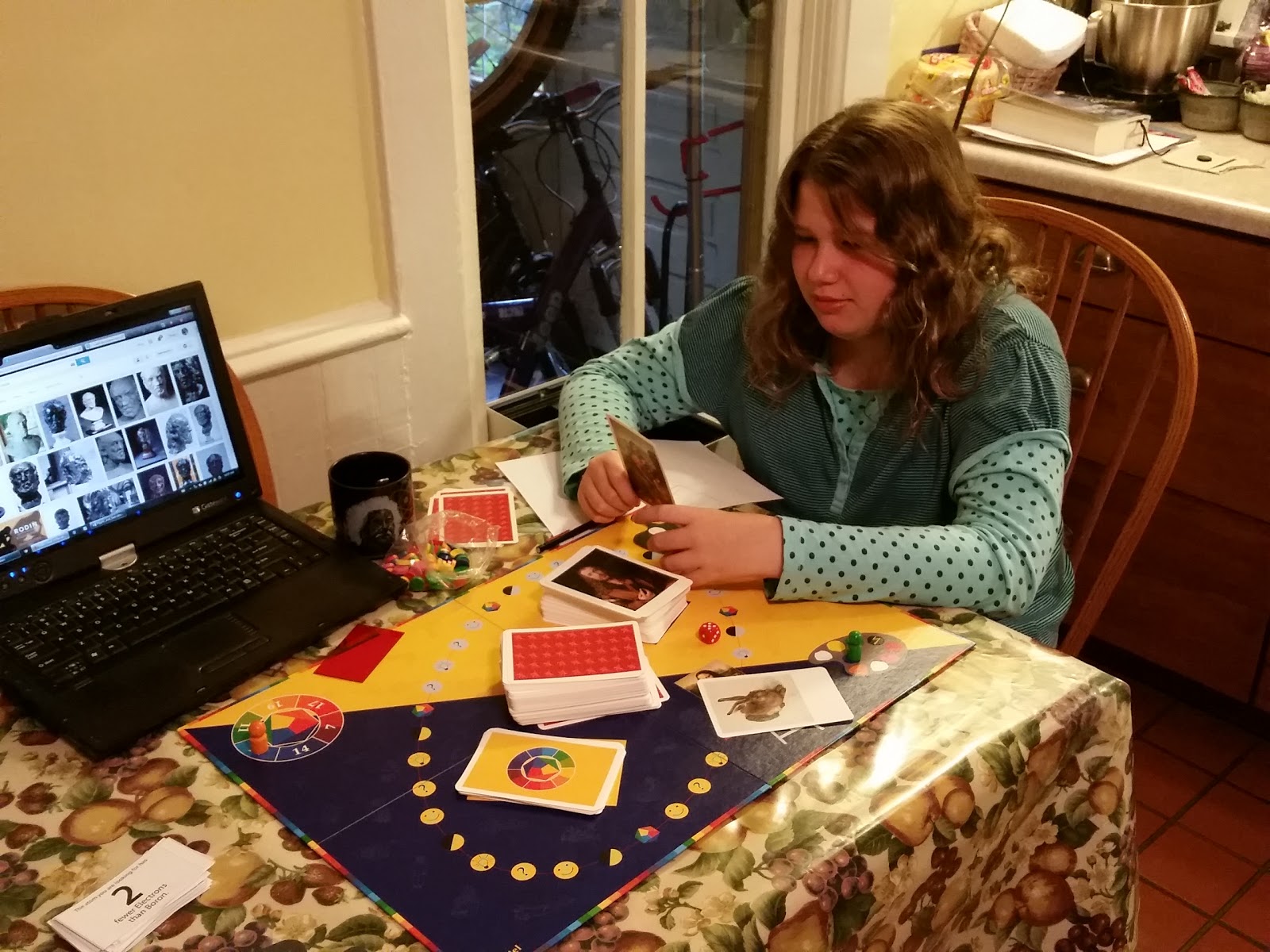
This year "Art Class" is about reading poetry (over tea, in bed at night, with breakfast, while studying theology...), listening to Classics for Kids radio, hearing excerpts from renowned pieces of literature, looking at types of architecture, placing styles of art & artists on a timeline, and....playing the Prestel Art Game!


We've been playing this for several weeks now, and it's pushed us to learn art terminology, recognize famous pieces, and learn about eras in art history. One thing I really appreciate is that you don't have to start out knowing a whole lot about art and artists in order to progress in the game. There are enough questions that are, "What do you think?" type questions to keep it moving. We use our creative and critical thinking skills to imagine what artists might be trying to say with a piece, what the subjects in a painting might be thinking, and what is most striking about certain pieces of artwork and why. Players "compete" with those questions by seeing if their answers match up with the answers of other players. There are also some "Pictionary" and "Taboo" type challenges.

As a way to extend the learning with this game, we keep the laptop around to look up other pieces of art by some artists or to search for similar styles and eras in art history!

Thursday, October 2, 2014

Game Schooling - Rummy Roots

We have always loved a good game here at Peregrin House! And this year I've been focusing on ways to integrate games into our regular schedule and curriculum. I'm thinking that we should begin calling ourselves Game Schoolers, rather than Home Schoolers. I've been clogging my facebook feed with photos of us playing all our new (and old) games and decided it's high time I get them all recorded in the blog!

One of my very favorite new games is Rummy Roots! I'd been considering all kinds of vocabulary curriculum ideas for the latter half of this year, once we finish Logic of English and was on the brink of purchasing some workbooks when I ran across this game at Heppner's Legacy Homeschool Resources store in Elk River, MN.


The first version of the game is basically "Go Fish," except the draw pile is the "Root Pile," and you "Go Dig!" Both Greek and Latin roots and their English translations are in the deck. You ask for either the Greek/Latin or the English root word to make your match. Players have a cheat sheet with all the roots listed. Later versions of the game are played like Rummy, combining the Greek/Latin roots to create words. A small lexicon is included for assistance in playing the Rummy version of the game.Scanning the list over and over to find the matching root is good practice for using alphabetical lists and good eye training for children with dyslexia. Memorization happens without a person even noticing!

For now, we're going to forgo the root word workbooks and play games!

Rummy Roots has a web page here: http://rummyrootsgames.com/

Monday, June 30, 2014

Tour De Nature Centers - Houston, MN

While on a camping trip in southern Minnesota, we took the opportunity to stop at Houston Nature Center, home of the International Owl Festival and the World Owl Hall of Fame! Houston Nature Center is also the trail head for the Root River Trail, a 60-mile paved trail connecting the MN cities of Houston, Rushford, Peterson, Whalen, Lanesboro, Fountain, Preston and Harmony.


The nature center features a Natural Playground:


Bicycle Sculptures:


And an indoor space with educational exhibits on OWLS...and caterpillars and turtles:


Tuesday, May 27, 2014

Tour De Nature Centers - Richardson

On our way home from the Cleary Lake camping trip we stopped by Richardson Nature Center. The exterior building design AND the indoor interpretive center space blew us away! If you live in the city with children and you want a nature-filled place to go without driving far, this is your place!


From the indoor viewing windows, we checked out the four resident beehives, hummingbirds, bluejays, chickadees, and a wild turkey!


Outside we encountered a goose and her babies, a painted turtle, and a fort-building space!


Again, we are worried about the summer mosquito population, but we just might brave it anyway to bring Mane and a group of her homeschool buddies out for a day of fort-building.

Monday, May 26, 2014

Tour De Nature Centers - Cleary Lake

While technically not a nature/interpretive center, Cleary Lake Regional Park offers plenty of wide open space and nature-centered activities for nature-seekers like ourselves! The building features a "snack shop," fireplace, and indoor/outdoor seating.


We camped at one of the "hike-in" campsites in the Basswood Campground over Memorial weekend. There were carts for hauling stuff to the campsite. (Alas, if only we could have snagged one of those on this busiest of all busy camping weekends, though none of the sites were so far from the parking space that hauling everything was overly burdensome.)
The campground does not have showers, but it does have clean pit toilet buildings (solid wood structure, cement floors  - not standard outhouses), and the main visitor center and beach building both have flush toilets and sinks with running water.

We enjoyed a trip around the two islands in Cleary Lake on a paddle boat. The park rents out paddle boats, canoes and kayaks. (And there's a group camp site on one of the islands!)

The beach was a busy place during the daytime, but the chilly mornings & evenings found it still and  quiet:

Cleary Lake also offers a Pavilion rental space for events. They were setting up for a wedding inside. Otherwise, I might have taken more photos! The round fireplace in the center of the building, along with the vaulted ceiling and windows overlooking the lake make the building both seem cozy and expansive...

A view from the campground peninsula of the beach & rental building across the lake:

We are a little worried that the mosquitoes might be bad here in the summer. There are lots of little marshy areas and ponds. But it was a lovely place for a spring camping trip - less than 40 minutes from home and tucked back in the trees!

Related Posts with Thumbnails