Thursday, April 23, 2015

Game Schooling - Chess


Do I really need to say more? You all know what chess is, right? But I always forget how much I enjoy playing, and the educational benefits are considerable. Chess is a game of strategy, requiring a whole lot of both planning and flexibility. There are entire conferences and considerable research studies devoted to the benefits of playing chess. From The Susan Polgar Foundation: Excel Through Chess:

Countless researchers and studies have shown over the years that chess does indeed strengthen a child's mental clarity, fortitude, stability, and overall health. Many schools are now finding chess as an inexpensive but essential way of helping kids grow mentally. In this technologically driven world, chess helps aid in the synthesis and growth of certain areas in the brain and mind where many children can benefit as they grow older from the game.
In 1986 a program called Chess-In-The-Schools was introduced in New York City to promote chess as a tool for developing essential skills for school children. The program is still going strong today. In 1992 New Jersey passed a bill requiring all students in New Jersey schools to be taught to play chess in the 2nd grade!  And just this April a senator in California introduced a bill to designated October as "California Chess Month," recognizing both the educational value and popularity of the game.

For an interesting history of chess, beginning with its origins in India around 600AD, check out the United States Chess Federation website. Fortunately for all of us, chess is available in a multitude of forms today - from high-end, hand-carved display games to mobile apps, and resources for everything from basic game rules to complex strategies can be found all over the internet. So, go dig out the old dusty box in your game closet, and start playing chess!!

Thursday, January 29, 2015

Chemistry Lessons - Dissolving Salt & Sugar

Dissolving M&Ms (sugar) in water & alcohol
It's been a while since I've checked in about our chemistry class this year! Over the last month we've played with dissolving salt and sugar in water, alcohol and oil. We've discovered how the polarity of molecules affects how quickly the molecule can dissolve salt or sugar (if it can dissolve it at all).  Here's Mane in action:

Model of water dissolving salt
Dissolving M&Ms in water, alcohol & oil
We have continued to be very happy with MiddleSchoolChemistry.com! It's taken a lot longer to work through the lessons that I thought it would because we are doing every experiment and project in the lessons unless we absolutely cannot find materials. The early lessons were a breeze. The later lessons are more dense, and both Mane and I are getting a lot out of them! I'm understanding chemistry a lot better than I did in college!

Wednesday, January 28, 2015

Germanic American Institute


In early January we visited the Germanic American Institute in St. Paul for their Kaffeestube European Breakfast Cafe. It was Mango's birthday, and he'd been telling nostalgic stories about his trip to Germany in high school. German breakfast is something he always fondly recalls - dense breads, cold cuts, pickles, tomatoes, cucumbers, boiled eggs, yogurt & berries. And we were not disappointed by Kaffeestube:


After breakfast, we explored the building. The second floor houses a gallery. The current display is called Remembering Der Mauerfall and features photographs commemorating the fall of the Berlin Wall:

The library is full of books, games and movies in German!

A side sitting room was still decorated for Christmas...

The 3rd floor ballroom was very sweet!

The GAI hosts a number of events throughout the year, including German classes, discussion groups, parties, and dinners! In February they're offering a FREE yodeling class!! Check out their Events Page for more information.

Tuesday, January 27, 2015

Game Schooling - Xoom Cubes

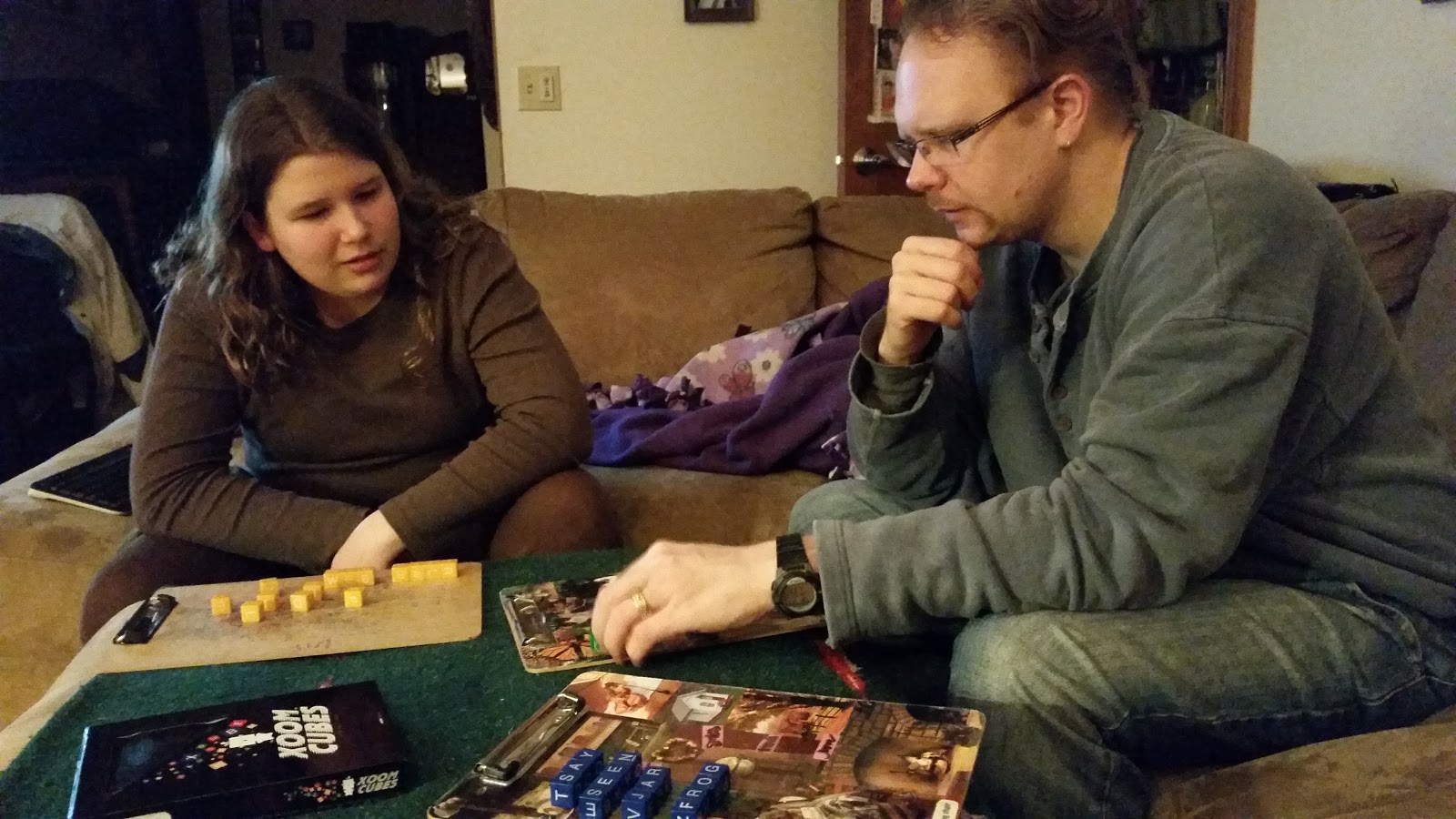
We're still learning all the fun possibilities for game-play with Xoom Cubes, but already they are a giant hit at our house. I attended a Teacher Tuesday at Marbles: The Game Store, and I received this game for FREE!


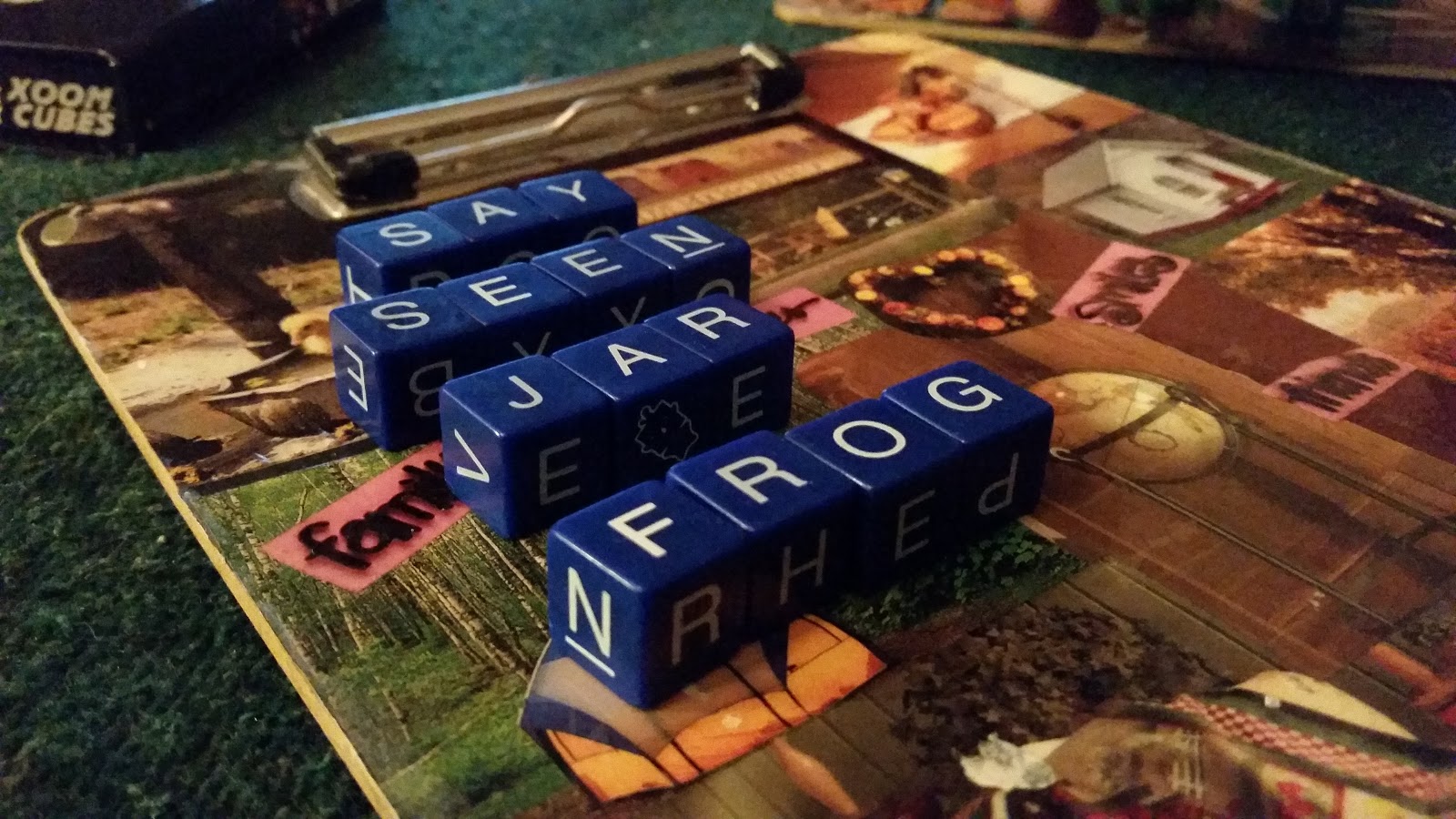
Xoom Cubes is really just a box of alphabet cubes/dice in 4 different colors. One way to play: Each player gets a set of colored dice, rolls the dice, and creates words using as many of their letters as possible.


Variations include using a timer, creating a crossword, allowing re-rolling of unused dice, or pooling all the dice and racing to create words from the pool. Of course, the cubes could also be used with younger kids for matching letters and learning phonics! For more game suggestions and Xoom Cubes challenges, check out the Xoom Cubes website: http://baxbo.com/games/xoom-cubes/ or the facebook page: https://www.facebook.com/xoomcubes.

Monday, January 26, 2015

Game Schooling - Puzzles

I know many seasoned homeschool parents who will say that their number one must-have homeschool tool is puzzles. And there's a fair amount of research about the educational value of jigsaw puzzles. Puzzles provide practice in deductive reasoning, categorization, analysis, sequencing, problem solving, spacial awareness, and scanning - skills that transfer especially well to the "academic" subjects of reading, math, and science. For the kinesthetic learner, puzzles can also be a hands-on way to work with subject matter. Example: We recently picked up a puzzle map of New York City. We'll be visiting New York this summer, and the puzzle is providing all of us with a hands-on way of familiarizing ourselves with the city.  We're developing a sense of the direction, distance, and general layout of places in the city. The puzzle is a conversation piece, as we discover street names and buildings, and it's a starting point for new learning about the city.

AND, "puzzling" is a fun social activity:


Saturday, January 24, 2015

Game Schooling - Qwirkle


We added Qwirkle to the stack of games at our house over Christmas break this year. It came highly recommended from a educator friend, and is the winner of several game awards. I've heard is described as scrabble with colors and symbols rather than letters. MindWare describes the game in this way:
Qwirkle is as simple as matching colors and shapes, but this game also requires tactical maneuvers and well-planned strategy. Earn points by building rows and columns of blocks that share a common shape or color. Look for opportunities to score big by placing a tile that touches multiple pieces with matching attributes.
We've now played Qwirkle over and over (since our Christmas purchase), and every time we play, the high score gets higher! We're beginning to wonder how high it's actually possible to score in this game. One of the keys seems to be flexible thinking - the ability to shift from one plan to another and see all the various ways to play the same piece. There's also some balance to be had between cooperating with other players and throwing a wrench in the perfect rows and columns!

For serious Qwirkle players, MindWare has created Expansion Sets, Qwirkle Cubes (like the tiles, only multi-sided dice!), and Travel Qwirkle.

Friday, January 23, 2015

Game Schooling - Mancala


I've always found mancala to be such a beautiful and simple game. Who doesn't enjoy handfuls of gems? We used to play mancala with egg cartons when Mane was younger, but a friend gave us this lovely wooden mancala board last year!


Mancala is easy to learn and quick to play - deceptively quick and easy, for a surprising amount of strategy comes into play as players become more experienced. Dr. Gwen Dewar at Parenting Science describes mancala as a "count and capture" game that requires strategic mental planning, deductive reasoning and math skills. (For a blow-your-mind research paper on the mathematics involved in mancala, check this out: Mancala Games - Topics in Mathematics and Artificial Intelligence.) According to The Geek Parent, mancala may be the oldest board game in the world!! Clearly, this game has a lasting appeal. Wikipedia has a fantastic listing of various mancala games and links to their rules here: Wikipedia: Mancala Games.


And here's all you really need to get started (from education.com):


Also known as "count and capture" games, mancala games encourage kids to conduct thought experiments, counting tokens and comparing tactics in their heads before they move a game piece. Such qualities have inspired educators in Africa, Europe, and the United States to bring mancala into the classroom.

Does playing mancala actually sharpen math and thinking skills? To date, nobody has performed the relevant experiments to find out. However, competent performance requires counting and the mental movement of game tokens across a game board. And research suggests that good players use abstract or hypothetico-deductive reasoning (Retschitzki et al 1986). - See more at: http://www.parentingscience.com/mancala-games.html#sthash.xzhVgHdT.dpuf
Also known as "count and capture" games, mancala games encourage kids to conduct thought experiments, counting tokens and comparing tactics in their heads before they move a game piece. Such qualities have inspired educators in Africa, Europe, and the United States to bring mancala into the classroom.

Does playing mancala actually sharpen math and thinking skills? To date, nobody has performed the relevant experiments to find out. However, competent performance requires counting and the mental movement of game tokens across a game board. And research suggests that good players use abstract or hypothetico-deductive reasoning (Retschitzki et al 1986). - See more at: http://www.parentingscience.com/mancala-games.html#sthash.xzhVgHdT.dpuf

Tuesday, December 30, 2014

Game Schooling - Dread Pirate


While not technically an "educational" game, Dread Pirate is a beautifully crafted family game. It's fast moving and suitable for players of all ages. For the younger set, counting dice and planning a route provide some educational value. For the older set, the pirate lore on the playing cards provides an entertaining education about famous pirates.


Monday, December 29, 2014

St. Paul Winter Skate

Wells Fargo WinterSkate rink in St. Paul is a beautiful place to skate!


We went for the ambiance and loved the holiday lights, the horse-drawn carriage clip-clopping down the street nearby, and the cozy warming house!


Inside the warming house, looking out on the rink!

Sunday, December 28, 2014

Museum of Russian Art

One of Mane's Christmas gifts this year was getting to pick out her own matryoshka doll from Russia! We ordered from: Matryoshka Dolls. And then we took a trip to The Museum of Russian Art.


The museum is practically right in our back yard (though not quite so close as the Minneapolis Institute of Art), right off 35W and Diamond Lake Road, and we couldn't believe we'd never been there!

Current displays include "Winter Holidays in the Soviet Era," with "New Year" ornaments, memorabilia, and propaganda from the time when the Soviet Union forbid the celebration of Christmas and tried to replace it with the New Year. Another exhibit called "Life on the Edge of the Forest" celebrated the woodwork and forests of Russia, primarily with displays of window frames and distaffs:


A third display had watercolor paintings of mushrooms by current artist, Alexander Viazmensky. His paintings are used in botanical texts because of their accuracy and detail. 

The permanent collection included beautiful works depicting the Russian countryside and some small churches:


Related Posts with Thumbnails