Showing posts with label Game Schooling. Show all posts

Monday, June 8, 2015

Game Schooling - Munchkin Quest

Looking for a fun, humorous, strategy game to play on a long, rainy evening? Munchkin Quest is your answer!  Be warned that it takes a while to learn how to play. And the game cards can be slightly inappropriate - in a medieval and/or renaissance fair kind of way. I wouldn't attempt to play with kids under 12. Having said that, it's one of our games of choice for a family game night. Players build the board as they go. Every time a player adds a new room to the board, a monster appears, and they have to fight the monster by combining dice rolls with the cards they have in play. As players defeat monsters, they move up levels until they return to the center of the board and fight the "Boss Monster" to win the game. Turns are long and can include adding new rooms, fighting monsters, running from monsters, dropping treasure, searching for treasure, scoring cards, and giving charity! (This gives other players plenty of time to eat all the snacks, get something to drink, and change the music!) It's a great game for practicing strategy and logic...and laughing a lot!

Wednesday, June 3, 2015

Game Schooling - Storage Edition

Plastic soap containers or similarly-sized snack containers work great for storing card games:
I found these at the dollar store. I love that the lid clips to close the container. Now we can do away with rubber binders holding decks of cards together!

Wednesday, April 29, 2015

Game Schooling - Quick Pix Animals


I picked this game up for next to nothing at the homeschool book sale about a month ago, and then I saw it at the science museum store. You know it's a good game when they're selling it at the science museum!

How to Play:
Each player gets 5 cards, which they place face-up in front of themselves. Each card has two animal categories, such as "mammals" or "reptiles" on it. The deck contains animal picture cards. When a card from the deck is flipped up, the first player to match their category card to the animal card keeps the match. I require older kids to call out the correct category, not just slap the right category card down on the animal.


We're finding that even our smallest player is getting pretty good at this game! The category cards have pictures of the animals on them. So, he can identify the matches by using the pictures:

Just look at his card stash on the couch there!
Learning:
Younger players practice matching/patterning and eye scanning skills. Older players learn animal classification. Grown-up players learn to be quick...because the kids are FAST! The game rules come with information about classification and all the animals included in the deck. Even our adult players learned some new things about some animals from this game. (Did you know that manatees are hoofed mammals? And that the porcupine is considered a rodent?)


Tuesday, April 28, 2015

Game Schooling - Quiddler


I cannot believe I've made it this long without playing Quiddler! The game came out in 1998, and TDmonthly lists it as one of the top ten most wanted cards games STILL in 2014. The Card Game Reviews blog says:
Quiddler has won more than a dozen gaming awards, including a MENSA Select Award, a spot on Newsweek‘s Perfect Presents list, and the 1998 Tiger Award for Best American Game.
The game comes with a fat stack of letter cards, which players make into words. Play is simple, following a draw and discard format. Round 1 starts with 3 cards (meaning players will be making 3-letter words). Round 2 begins with 4 cards, Round 3 with 5, etc... up to 10 cards. Players must use their entire hand (minus 1 card to discard) to make 1 or more words with the highest point value. House rules could make this game easier or harder for kids of different ages. Those just learning to read could make shorter words than experienced readers. The deck could be stacked to include (or not include) letter blends. Players could decide to play up to a certain point value, rather than a certain number of rounds or to play all rounds with the same number of letters.

As a card game, Quiddler is delightfully small and pack-able, and Mane commented on how much she likes the design of the letters! I love a game that is beautiful, educational AND portable. This one definitely has some camping/road trips in its future!

Thursday, April 23, 2015

Game Schooling - Chess


Do I really need to say more? You all know what chess is, right? But I always forget how much I enjoy playing, and the educational benefits are considerable. Chess is a game of strategy, requiring a whole lot of both planning and flexibility. There are entire conferences and considerable research studies devoted to the benefits of playing chess. From The Susan Polgar Foundation: Excel Through Chess:

Countless researchers and studies have shown over the years that chess does indeed strengthen a child's mental clarity, fortitude, stability, and overall health. Many schools are now finding chess as an inexpensive but essential way of helping kids grow mentally. In this technologically driven world, chess helps aid in the synthesis and growth of certain areas in the brain and mind where many children can benefit as they grow older from the game.
In 1986 a program called Chess-In-The-Schools was introduced in New York City to promote chess as a tool for developing essential skills for school children. The program is still going strong today. In 1992 New Jersey passed a bill requiring all students in New Jersey schools to be taught to play chess in the 2nd grade!  And just this April a senator in California introduced a bill to designated October as "California Chess Month," recognizing both the educational value and popularity of the game.

For an interesting history of chess, beginning with its origins in India around 600AD, check out the United States Chess Federation website. Fortunately for all of us, chess is available in a multitude of forms today - from high-end, hand-carved display games to mobile apps, and resources for everything from basic game rules to complex strategies can be found all over the internet. So, go dig out the old dusty box in your game closet, and start playing chess!!

Tuesday, January 27, 2015

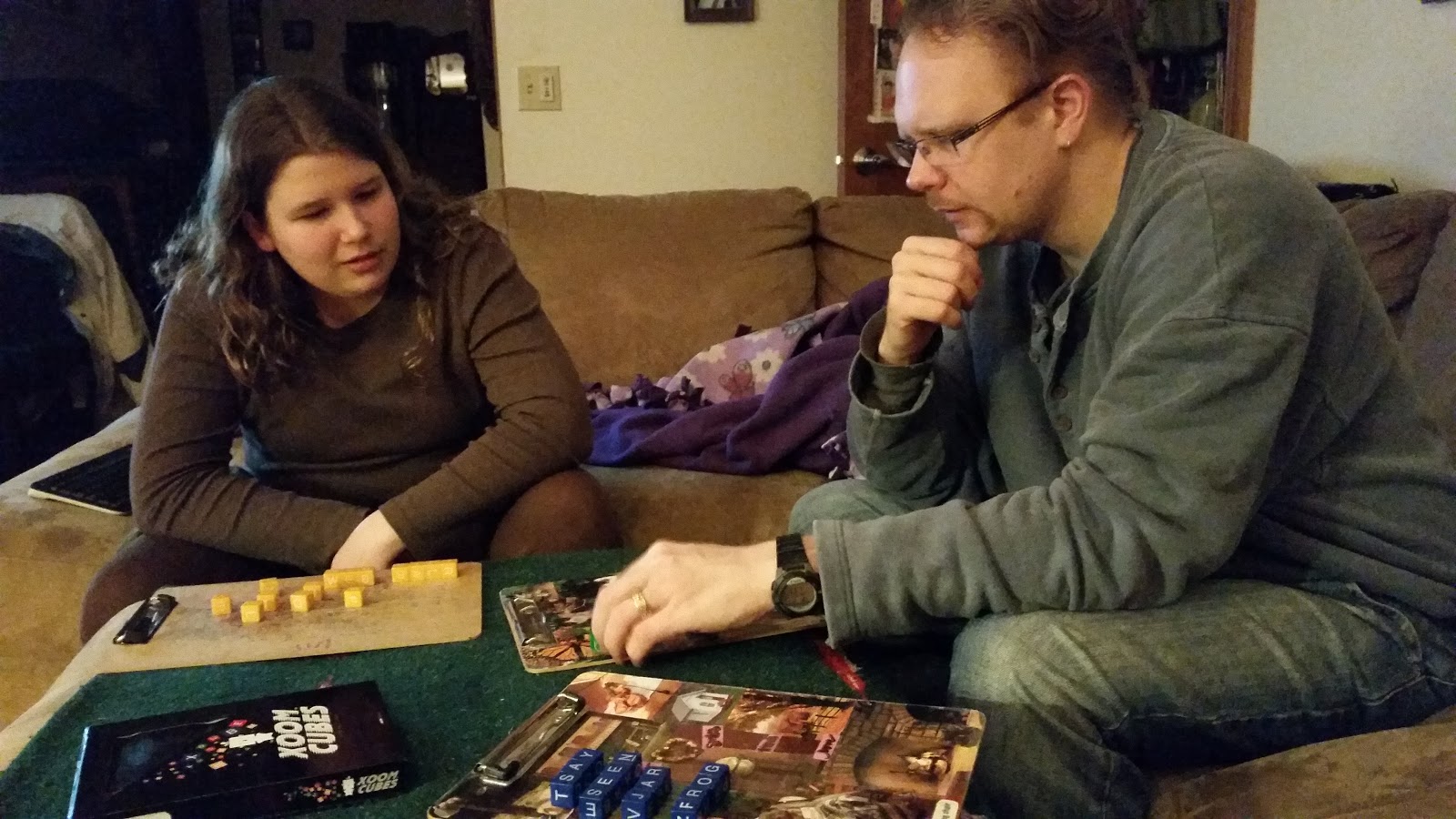
Game Schooling - Xoom Cubes

We're still learning all the fun possibilities for game-play with Xoom Cubes, but already they are a giant hit at our house. I attended a Teacher Tuesday at Marbles: The Game Store, and I received this game for FREE!


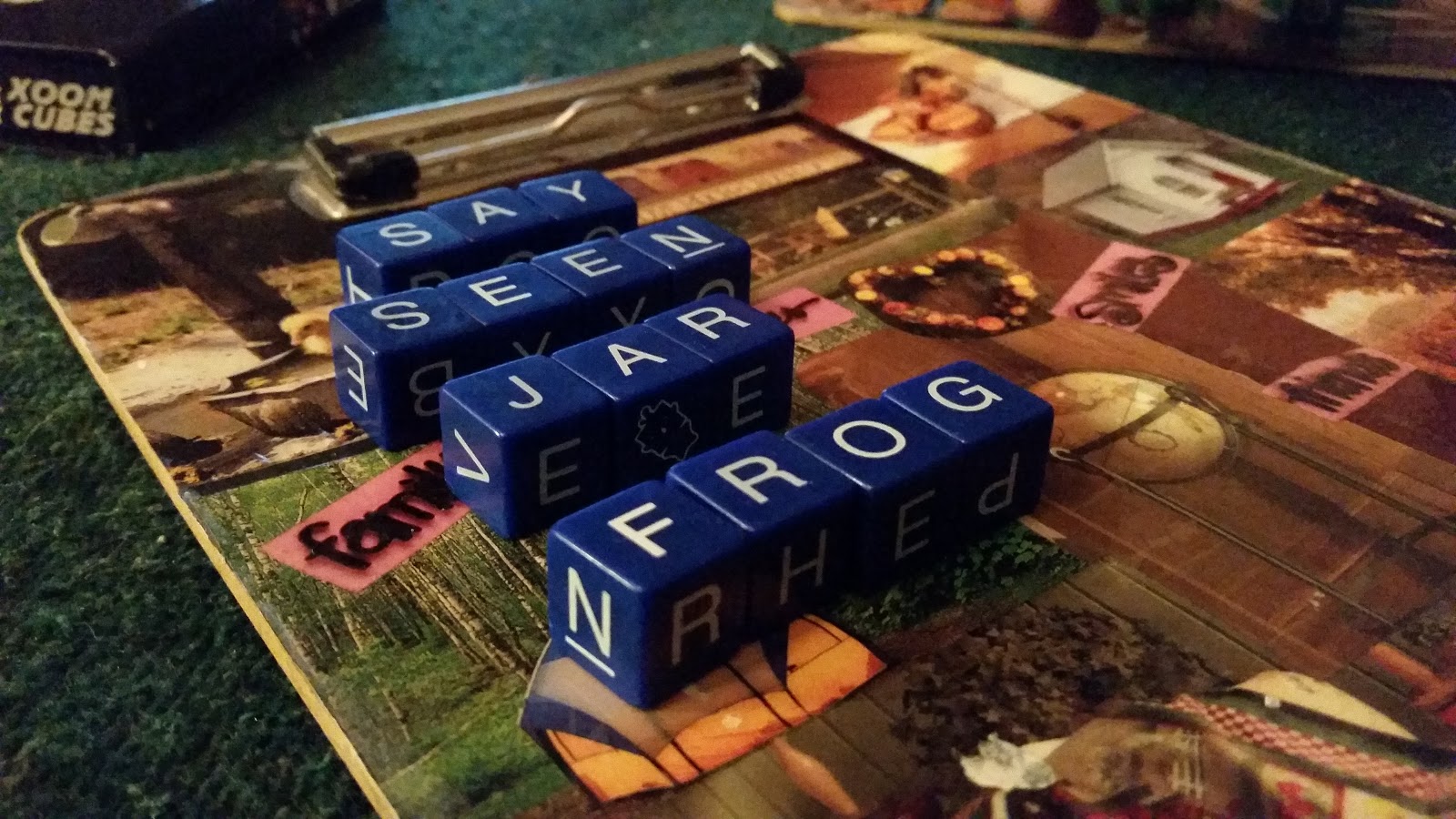
Xoom Cubes is really just a box of alphabet cubes/dice in 4 different colors. One way to play: Each player gets a set of colored dice, rolls the dice, and creates words using as many of their letters as possible.


Variations include using a timer, creating a crossword, allowing re-rolling of unused dice, or pooling all the dice and racing to create words from the pool. Of course, the cubes could also be used with younger kids for matching letters and learning phonics! For more game suggestions and Xoom Cubes challenges, check out the Xoom Cubes website: http://baxbo.com/games/xoom-cubes/ or the facebook page: https://www.facebook.com/xoomcubes.

Monday, January 26, 2015

Game Schooling - Puzzles

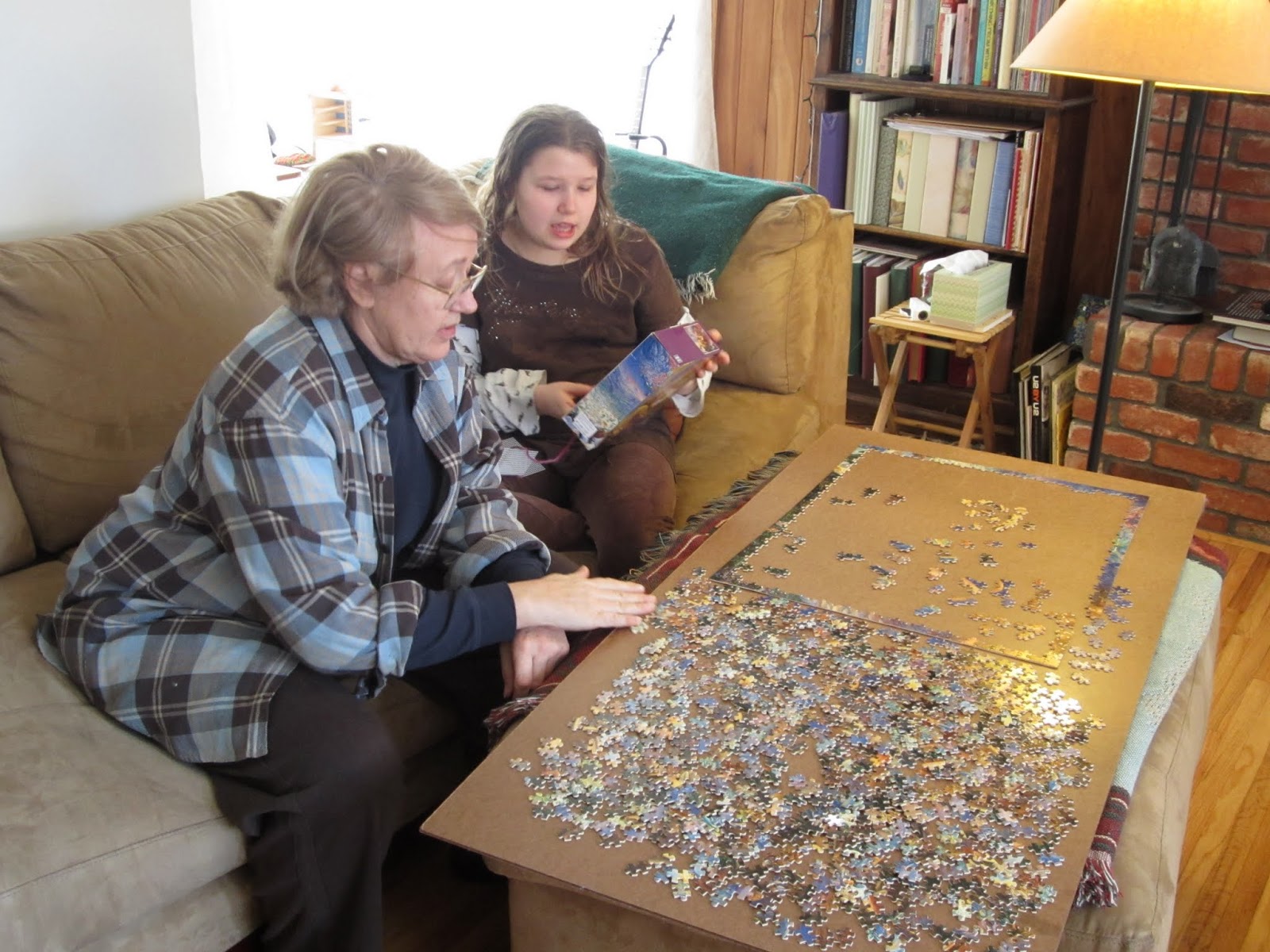
I know many seasoned homeschool parents who will say that their number one must-have homeschool tool is puzzles. And there's a fair amount of research about the educational value of jigsaw puzzles. Puzzles provide practice in deductive reasoning, categorization, analysis, sequencing, problem solving, spacial awareness, and scanning - skills that transfer especially well to the "academic" subjects of reading, math, and science. For the kinesthetic learner, puzzles can also be a hands-on way to work with subject matter. Example: We recently picked up a puzzle map of New York City. We'll be visiting New York this summer, and the puzzle is providing all of us with a hands-on way of familiarizing ourselves with the city.  We're developing a sense of the direction, distance, and general layout of places in the city. The puzzle is a conversation piece, as we discover street names and buildings, and it's a starting point for new learning about the city.

AND, "puzzling" is a fun social activity:


Saturday, January 24, 2015

Game Schooling - Qwirkle


We added Qwirkle to the stack of games at our house over Christmas break this year. It came highly recommended from a educator friend, and is the winner of several game awards. I've heard is described as scrabble with colors and symbols rather than letters. MindWare describes the game in this way:
Qwirkle is as simple as matching colors and shapes, but this game also requires tactical maneuvers and well-planned strategy. Earn points by building rows and columns of blocks that share a common shape or color. Look for opportunities to score big by placing a tile that touches multiple pieces with matching attributes.
We've now played Qwirkle over and over (since our Christmas purchase), and every time we play, the high score gets higher! We're beginning to wonder how high it's actually possible to score in this game. One of the keys seems to be flexible thinking - the ability to shift from one plan to another and see all the various ways to play the same piece. There's also some balance to be had between cooperating with other players and throwing a wrench in the perfect rows and columns!

For serious Qwirkle players, MindWare has created Expansion Sets, Qwirkle Cubes (like the tiles, only multi-sided dice!), and Travel Qwirkle.

Friday, January 23, 2015

Game Schooling - Mancala


I've always found mancala to be such a beautiful and simple game. Who doesn't enjoy handfuls of gems? We used to play mancala with egg cartons when Mane was younger, but a friend gave us this lovely wooden mancala board last year!


Mancala is easy to learn and quick to play - deceptively quick and easy, for a surprising amount of strategy comes into play as players become more experienced. Dr. Gwen Dewar at Parenting Science describes mancala as a "count and capture" game that requires strategic mental planning, deductive reasoning and math skills. (For a blow-your-mind research paper on the mathematics involved in mancala, check this out: Mancala Games - Topics in Mathematics and Artificial Intelligence.) According to The Geek Parent, mancala may be the oldest board game in the world!! Clearly, this game has a lasting appeal. Wikipedia has a fantastic listing of various mancala games and links to their rules here: Wikipedia: Mancala Games.


And here's all you really need to get started (from education.com):


Also known as "count and capture" games, mancala games encourage kids to conduct thought experiments, counting tokens and comparing tactics in their heads before they move a game piece. Such qualities have inspired educators in Africa, Europe, and the United States to bring mancala into the classroom.

Does playing mancala actually sharpen math and thinking skills? To date, nobody has performed the relevant experiments to find out. However, competent performance requires counting and the mental movement of game tokens across a game board. And research suggests that good players use abstract or hypothetico-deductive reasoning (Retschitzki et al 1986). - See more at: http://www.parentingscience.com/mancala-games.html#sthash.xzhVgHdT.dpuf

Tuesday, December 30, 2014

Game Schooling - Dread Pirate


While not technically an "educational" game, Dread Pirate is a beautifully crafted family game. It's fast moving and suitable for players of all ages. For the younger set, counting dice and planning a route provide some educational value. For the older set, the pirate lore on the playing cards provides an entertaining education about famous pirates.


Friday, December 5, 2014

Game Schooling - Sequence

She won!
Sequence comes in a bazillion different forms (States & Capitals, Letters, Numbers, Bible, Travel, Jumbo...), but all we've got here is the original playing card version. I realized as I was playing with my friend's 5yr old the other day how valuable this game is, not only for number recognition, but also for eye scanning and tracking skills (same principle as word finds). This is helpful for both the pre-reader and readers, who are building fluency. Having read a whole lot about dyslexia, I'm aware that eye training exercises can be part of skill-building and therapy for kids with dyslexia. Hats off to another fun learning game!

We let the little guy have the edge of the board for his tokens!


Friday, November 21, 2014

Game Schooling - Gobblet


Gobblet is another logic game, a smart spin-off from tic tac toe. Mindware.com says:
This game has won more awards than we can fit in this space-and no wonder, with astonishingly easy rules and addictive, fast-moving play. Players place four pieces in a row to win, "gobbling" their opponent's pieces. A wonderful exercise in strategy and logic.

This is another game we received when Mane was about 5, and it was an instant hit with both older and younger folks in the family. I even had a good friend of mine playing round after round with me on a camping trip a few summers ago! As Mane gets older, her play gets more sophisticated. It's great practice for learning to stay focused and attentive, too.  It reminds me of chess because of the way that you have to "see" several different possibilities for your opponent's next move. In Gobblet you have to plan for bigger pieces to be able to "gobble" littler pieces and strategically place the larger pieces that cannot be "gobbled."


Friday, November 14, 2014

Game Schooling - Blokus


I had a lot of fun this week teaching my friend's 5yr old to play Blokus! (And the 2yr old played his own pieces with help from both of us)! In 2011 Blokus was featured in the journal Mathematics Teaching in Middle School, and was cited as teaching students to "exercise spatial awareness, analyze attributes of two-dimensional shapes, compare patterns, and use logic -all of which encompass NCTM's Content Standards."

We started playing Blokus when Mane was five and received it as a Christmas gift. The whole family loved the game. We took it on a family vacation, and it was enjoyed by the 5yr old, the 17yr old, and both parents! That's definitely a win! Blokus gets more complicated as players develop the skills listed in the journal article. A review at The Guide for Toys says this:
Blokus Classic is an award-winning game of strategy in which players compete to be the first to place each of their 21 colored pieces on the game board.  With each color beginning at one corner of the board, each piece must touch at least one other piece of the same color but only at the corners.  With every move, players use thinking skills for strategical moves and blocks.  The game ends when all players are blocked from laying down any more pieces. The player with the highest point total based on number of pieces played and any bonuses, wins.


Monday, October 13, 2014

Game Schooling - IZZI

We found this logic puzzle at the thrift store the other day...solvable in dozens of different ways - if you can manage to solve it all!! Simply match up the edges of each piece until you've build the entire 8x8 square:


It's a little like trying to do a rubics cube - infuriating and addicting.

Tuesday, October 7, 2014

Game Schooling - Games for the younger set...

I also have the great pleasure of walking alongside a friend of mine as she begins the homeschool journey. Her kids love to play games at my house, too!

Among the favorites:

Tenzi - Throw a set of dice (Tenzi is supposed to be with 10 dice, but we started with 5 and worked our way up.) Decide on which number you're going to "collect." Keep the dice showing that number and throw the rest of the dice again. Keep any of the number you are collecting, and then throw the dice again...until all your dice are gone. With older children this can be a speed game. This works on counting and number recognition for the smaller kids:


War - Remove non-numeric cards from the deck and deal the rest between 2 players. Players turn up their top card at the same time. Whoever has the higher number takes the trick. Keep playing until all the cards are gone. Then practice counting even higher by counting who has the most cards!:


Hide and Eek - This game works on the concepts of odd/even and higher/lower for numbers 1-100. There is also a little memory work involved for cards that do not remain face-up. And there is some strategy for where to move the mouse once you've rolled the dice and know whether you're trying to land next to numbers that are odd/even or higher/lower:


Scrambled States of America - This game works on letter recognition (example: find your states the begin with the letter "A") and syllables (example: find a state whose capital has 3 syllables) along with state recognition by shape and location. Fun and quick enough for the big kids to enjoy with the little kids. Bigger kids will catch on to state capitals and nicknames, but this game is not so rigorous that I would include it in the learning games for middle schoolers:

Sunday, October 5, 2014

Game Schooling - Mad Libs card game

Mane LOVES Mad Libs. I don't think I can express in words just how happy Mad Libs make her. If we get her nothing but Mad Libs books for her birthday, Christmas, and Chanukah this year, she would be over the moon. This is serious.

So, when I saw a Mad Libs card game at the thrift store for $1 the other day, I bought it. Don't let the serious face fool you, Mad Libs require your full attention:


As most of you probably know (but just in case you don't), Mad Libs are great for learning parts of speech and sentence construction. The game is played like Rummy, requiring players to make sentences of different lengths for each of six rounds. Cards are color coded for parts of speech.

We'd love to see Mad Libs get rid of the words "weirdo" and "dummy," though, and we'd love to see extension sets with better vocabulary. This game, which can be played similarly, is on our wish list: You've Been Sentenced.

Saturday, October 4, 2014

Game Schooling - Bible Challenge

It's been a struggle for me to find what I'm looking for in a Bible/Theology study for Mane. As a 7th grader, she's past just learning the basic stories but still needs reinforcement of the facts and practice finding things in scripture. There's a whole lot I have to say about teaching and studying theology for kids and middle schoolers, but today I'll just feature the games we've been using as that base for solidifying the facts and scriptures...


Mane made a set of these popsicle sticks with the books of the Bible written on them. They are color coded for genre. She is using them as a way to learn the order of the books. Scrambling them up and putting them back in order is great practice!

We are also playing a game called Bible Challenge as a part of our regularly scheduled curriculum! I grew up playing an older version of Bible Trivia, and I credit that game with helping me learn a great deal in a way that I still remember it today. This version does not give multiple choice answers to the questions, making it a bit more challenging. Players collect rings in seven different colors representing categories of questions in order to win the game.

Mango recently sent me a link to a American Radio Works radio show called The Science of Smart that was primarily about how people learn and retain information. Researchers have found over and over again that the best way to study information in order to retain it is to be quizzed (or to quiz yourself) on that information. It seems to me that trivia games are a great way to accomplish that repeated quizzing that helps us remember!

Friday, October 3, 2014

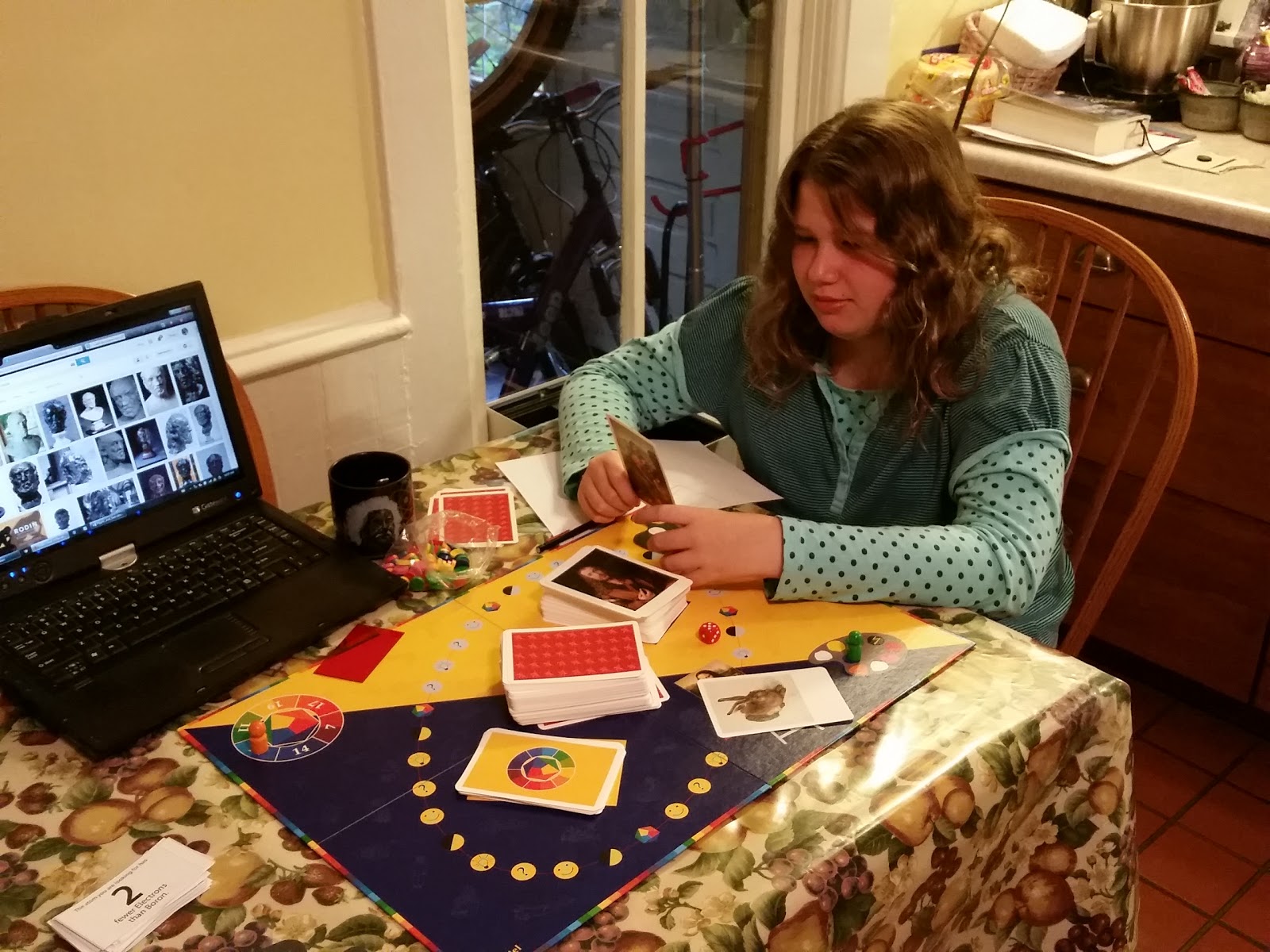
Game Schooling - Prestel Art Game

This year "Art Class" is about reading poetry (over tea, in bed at night, with breakfast, while studying theology...), listening to Classics for Kids radio, hearing excerpts from renowned pieces of literature, looking at types of architecture, placing styles of art & artists on a timeline, and....playing the Prestel Art Game!


We've been playing this for several weeks now, and it's pushed us to learn art terminology, recognize famous pieces, and learn about eras in art history. One thing I really appreciate is that you don't have to start out knowing a whole lot about art and artists in order to progress in the game. There are enough questions that are, "What do you think?" type questions to keep it moving. We use our creative and critical thinking skills to imagine what artists might be trying to say with a piece, what the subjects in a painting might be thinking, and what is most striking about certain pieces of artwork and why. Players "compete" with those questions by seeing if their answers match up with the answers of other players. There are also some "Pictionary" and "Taboo" type challenges.

As a way to extend the learning with this game, we keep the laptop around to look up other pieces of art by some artists or to search for similar styles and eras in art history!

Thursday, October 2, 2014

Game Schooling - Rummy Roots

We have always loved a good game here at Peregrin House! And this year I've been focusing on ways to integrate games into our regular schedule and curriculum. I'm thinking that we should begin calling ourselves Game Schoolers, rather than Home Schoolers. I've been clogging my facebook feed with photos of us playing all our new (and old) games and decided it's high time I get them all recorded in the blog!

One of my very favorite new games is Rummy Roots! I'd been considering all kinds of vocabulary curriculum ideas for the latter half of this year, once we finish Logic of English and was on the brink of purchasing some workbooks when I ran across this game at Heppner's Legacy Homeschool Resources store in Elk River, MN.


The first version of the game is basically "Go Fish," except the draw pile is the "Root Pile," and you "Go Dig!" Both Greek and Latin roots and their English translations are in the deck. You ask for either the Greek/Latin or the English root word to make your match. Players have a cheat sheet with all the roots listed. Later versions of the game are played like Rummy, combining the Greek/Latin roots to create words. A small lexicon is included for assistance in playing the Rummy version of the game.Scanning the list over and over to find the matching root is good practice for using alphabetical lists and good eye training for children with dyslexia. Memorization happens without a person even noticing!

For now, we're going to forgo the root word workbooks and play games!

Rummy Roots has a web page here: http://rummyrootsgames.com/

Tuesday, April 23, 2013

GAMES!

We've been enjoying so many games this year. Thought we'd share a few:


 And we seem to always have a puzzle going lately, too. Whenever Grandma walks into the house, she can't help but sit down & work on the puzzle for a while. This is our newest 1000 piece puzzle with all wooden pieces. The board stows nicely under the couch when we aren't working on it:


Related Posts with Thumbnails